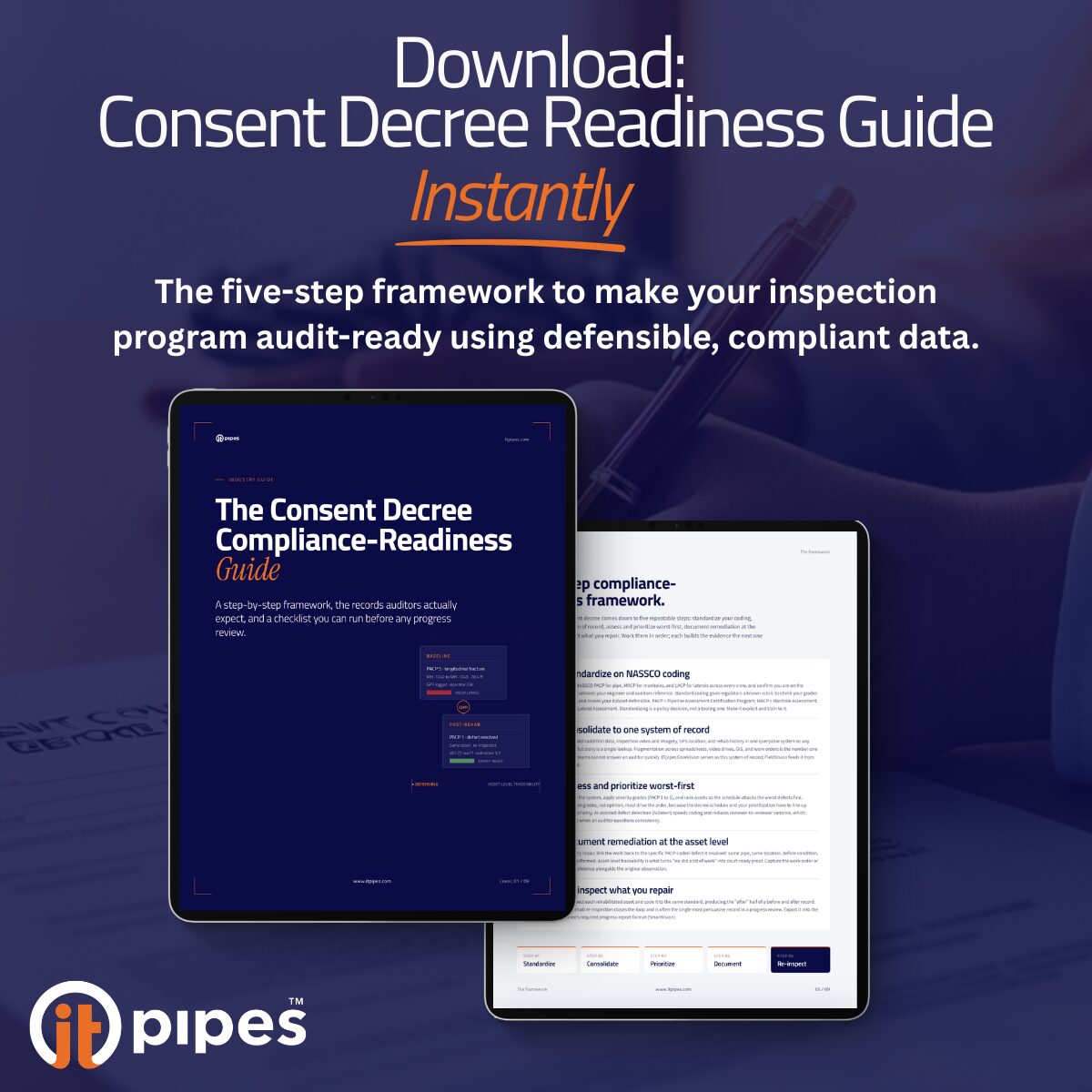
A consent decree changes what is expected of an organization overnight. Reporting timelines tighten. Documentation requirements expand. Every maintenance decision, capital investment, and operational change becomes subject to regulatory scrutiny. For organizations still operating on fragmented data and manual workflows, that shift can feel impossible to manage.
The organizations that navigate this successfully do not rely on effort alone. They build the underlying systems that make consistent, defensible compliance possible. And they do it early.
Why Disconnected Data Is the First Obstacle
Most organizations that enter a consent decree period carry significant data gaps. Inspection records live in spreadsheets. Work orders exist in one system and inspections in another. Field crews log findings on paper, and those findings may never make it into a centralized record at all.
This fragmentation does not only create inefficiency. It creates risk. When regulators ask why a particular main was not inspected, or how a rehabilitation priority was determined, the answer needs to be traceable. An organization that cannot reconstruct its own decision-making is in a weak position, not because the decisions were wrong, but because the documentation does not exist to support them.
A consent decree accelerates the need for a single source of truth. Asset inventories, inspection histories, work order records, and capital project status all need to be visible in one place, accessible to operations, engineering, finance, and leadership simultaneously. Without that foundation, teams spend more time reconciling data than acting on it.
Inspections as the Engine of the Program
Consent decrees typically require aggressive inspection timelines, and the structure of those timelines varies significantly depending on the size of the system, the nature of the violations, and what regulators determine poses the greatest risk. Some decrees require organizations to inspect following every sanitary sewer overflow (SSO) event within a defined window. Others organize inspections basin by basin over a multi-year schedule. What is consistent across decrees is the expectation that inspection work is prioritized, not random. Areas with recurring overflow history, proximity to sensitive receiving waters, known capacity shortfalls, and environmental justice considerations are routinely elevated in consent decree inspection plans.
What gets measured determines what gets managed. Organizations that treat inspection programs as a checkbox miss the strategic value embedded in that data. Each inspection result feeds into condition ratings, rehabilitation prioritization, and long-term capital planning. When sewer inspection platforms are integrated with asset management systems, the data collected in the field directly informs decisions made in the boardroom.
This integration also reduces the cost of compliance reporting. Instead of manually compiling performance metrics from multiple sources, program managers can pull current data directly from their inspection platform. Reports become faster to produce and easier to defend.
Standardization Is Not a Nice-to-Have
One of the most consistent findings in organizations under consent decrees is the absence of standardized workflows. Crews in different service areas use different methods to assess pipe condition. Different inspectors apply condition ratings inconsistently. Cleaning cycles vary based on crew habit rather than documented protocol.
In practice, standardization means defining what every inspection produces: consistent CCTV footage captured according to a documented protocol, defects coded to a recognized standard such as NASSCO’s Pipeline Assessment Certification Program (PACP), and condition ratings that are applied uniformly regardless of which crew performed the inspection. It means cleaning schedules driven by system data rather than institutional memory, and work orders that generate records rather than disappear into a verbal handoff.
These inconsistencies are not evidence of people doing bad work. They are evidence of systems that were never designed to produce comparable data at scale. A consent decree changes that requirement. Regulators expect defensible data, and defensible data requires consistent methods.
Standardizing inspection protocols, condition rating frameworks, and maintenance workflows across the organization is foundational work. It is not glamorous, and it rarely shows up in a milestone report. But it is what makes everything else reliable.
Building for Reporting Cadence, Not Just Milestones
Organizations sometimes focus all of their operational energy on milestone deadlines, such as the semi-annual inspection target or the quarterly SSO reduction goal, and neglect the reporting infrastructure needed to communicate progress credibly and continuously.
Regulators do not only want to see results at milestone dates. They want to see that the organization has the systems and discipline to track its own performance in real time. Monthly internal progress reviews, cross-departmental data reconciliation, and documented decision trails all signal that the organization is running a program, not improvising.
Building that reporting cadence early also creates visibility internally. When leadership can see where the program stands at any given time, they can make better decisions, allocate resources more accurately, and avoid the surprises that derail compliance timelines.
The Investment That Pays Beyond the Decree
The systems built during a consent decree period are not temporary. A modern inspection platform, a centralized asset management system, and standardized operational workflows do not become irrelevant when regulatory oversight ends. They become the foundation for a more reliable, more efficient utility long into the future.
Organizations that treat this infrastructure investment as a compliance cost miss the larger return. Those that treat it as a permanent operational upgrade, one that happens to be accelerated by regulatory requirements, position themselves to sustain improvements regardless of what regulatory environment comes next.
The consent decree creates the urgency. The systems built to meet that urgency create the lasting value.