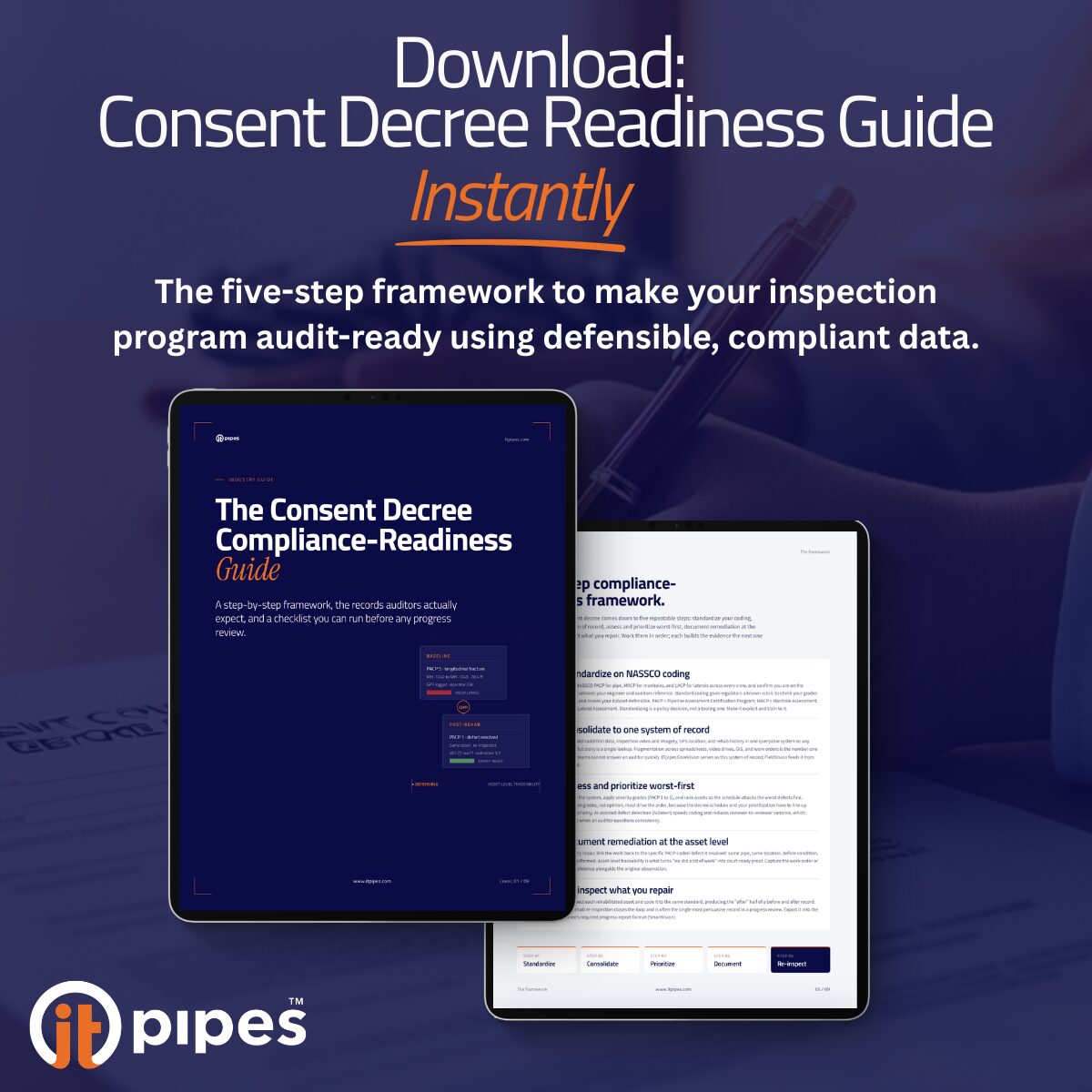
Consent Decree Management from Enforcement to Long-Term Compliance: The Complete Guide
What you will learn: How utilities avoid a consent decree and why timing decides the outcome, the five-step compliance-readiness framework that gets a program audit-ready, what auditors and courts expect from inspection records, and a pre-audit checklist you can run before any progress review.
Contents
A consent decree is one of the most significant operational events a utility can face. It formalizes years of systemic challenges under strict, enforceable oversight and demands improvements across capital planning, field operations, data management, and regulatory reporting.
But utilities that approach a consent decree strategically do not just survive it. They emerge with stronger systems, more disciplined operations, and a foundation for reliability that outlasts oversight. This guide covers what utilities need to know at every stage, from the moment a decree is issued to the years after it ends.
What Is a Consent Decree?
A consent decree is a legally binding agreement between a utility and a regulatory authority, typically the U.S. EPA or a state agency, that resolves violations of the Clean Water Act. Entered in federal court, it carries the full weight of a judicial order.
For municipal utilities, consent decrees most commonly arise from a pattern of sanitary sewer overflows (SSOs), combined sewer overflow violations, inadequate maintenance, or failure to meet NPDES permit requirements. They are not the result of a single incident, but the culmination of systemic issues regulators determined could no longer be left unaddressed. Once issued, a decree sets enforceable milestones, reporting requirements, and operational obligations on a defined schedule, often spanning ten to fifteen years or more.
The Three Stages of Consent Decree Management
Every stage demands a different approach. The priorities of year one are not the priorities of year five, and sustaining improvements after the decree ends is different again.
Stage 1: Reframing the Decree as an Opportunity
The utilities that manage decrees best resist treating them as punishment and instead approach them as a structured roadmap for transformation. The requirements a decree imposes, such as establishing a defensible baseline, centralizing data, standardizing operations, and building a capital improvement program, largely reflect improvements the utility already knew it needed.
The early months matter most. Utilities that quickly assign program ownership, build internal reporting routines, and address high-visibility problem areas gain credibility with regulators and create momentum that carries the program forward.
Stage 2: Building the Infrastructure of Compliance
Meeting a decree’s demands requires systems, not just effort. Utilities that rely on spreadsheets, disconnected databases, and manual reporting consistently struggle to keep pace. The foundational work centers on four areas:
Centralize your data. Asset inventories, inspection histories, work orders, and capital project status all need to be visible in one place. ITpipes CoreVision serves as the office system of record, where condition data, media, GIS, and rehab history live together, while ITpipes FieldVision syncs field data to office teams in real time.
Build an inspection program that drives decisions. Decrees require aggressive inspection timelines, but the real value is what the data enables: condition ratings, rehabilitation prioritization, basin sequencing, and defensible CIP scheduling aligned with decree milestones, especially when inspection software integrates with GIS and asset management systems.
Standardize workflows. Defensible data requires consistent methods: CCTV captured to protocol and defects coded to a recognized standard such as NASSCO PACP. ITpipes AiDetect strengthens consistency, increasing coding speed by over 50 percent while keeping NASSCO-certified experts in the review loop.
Report on cadence, not just at milestones. Regulators want to see real-time performance tracking. This is also where auditors focus: standardized coding, chain of custody on every record, media linked to each observation, and before-and-after re-inspection on repaired assets.
Stage 3: Sustaining Improvements After the Decree Ends
A decree terminates once the agency determines improvements are made and sustainable. But when external pressure lifts, performance tends to drift: inspection programs contract, platforms go underused, and old habits return.
Utilities that sustain their gains convert compliance activities into permanent standard operating procedures, assign ongoing ownership of their data infrastructure, and set internal performance targets that exceed what regulators required. The systems put in place are only as valuable as the discipline applied to using them after oversight ends.
Key Principles That Run Through Every Stage
Program thinking over crisis response. Decrees reward consistency. Predictable routines, clear ownership, and steady coordination keep you ahead of deadlines instead of chasing them.
Data as the foundation of every decision. From baseline to capital prioritization to reporting, every decision depends on the quality and accessibility of inspection data. Invest early and spend less time defending decisions and more time acting on them.
Regulatory relationships built on transparency. Regulators expect honesty, proactive communication, and evidence you control your own program, not perfection.
The long view on infrastructure investment. Delivered together as ITpipes SmartVision, the complete field-to-office solution, these systems become the operational foundation of a more reliable utility. Treat the investment as a permanent upgrade, not a compliance cost, and you sustain performance no matter what regulatory environment comes next.